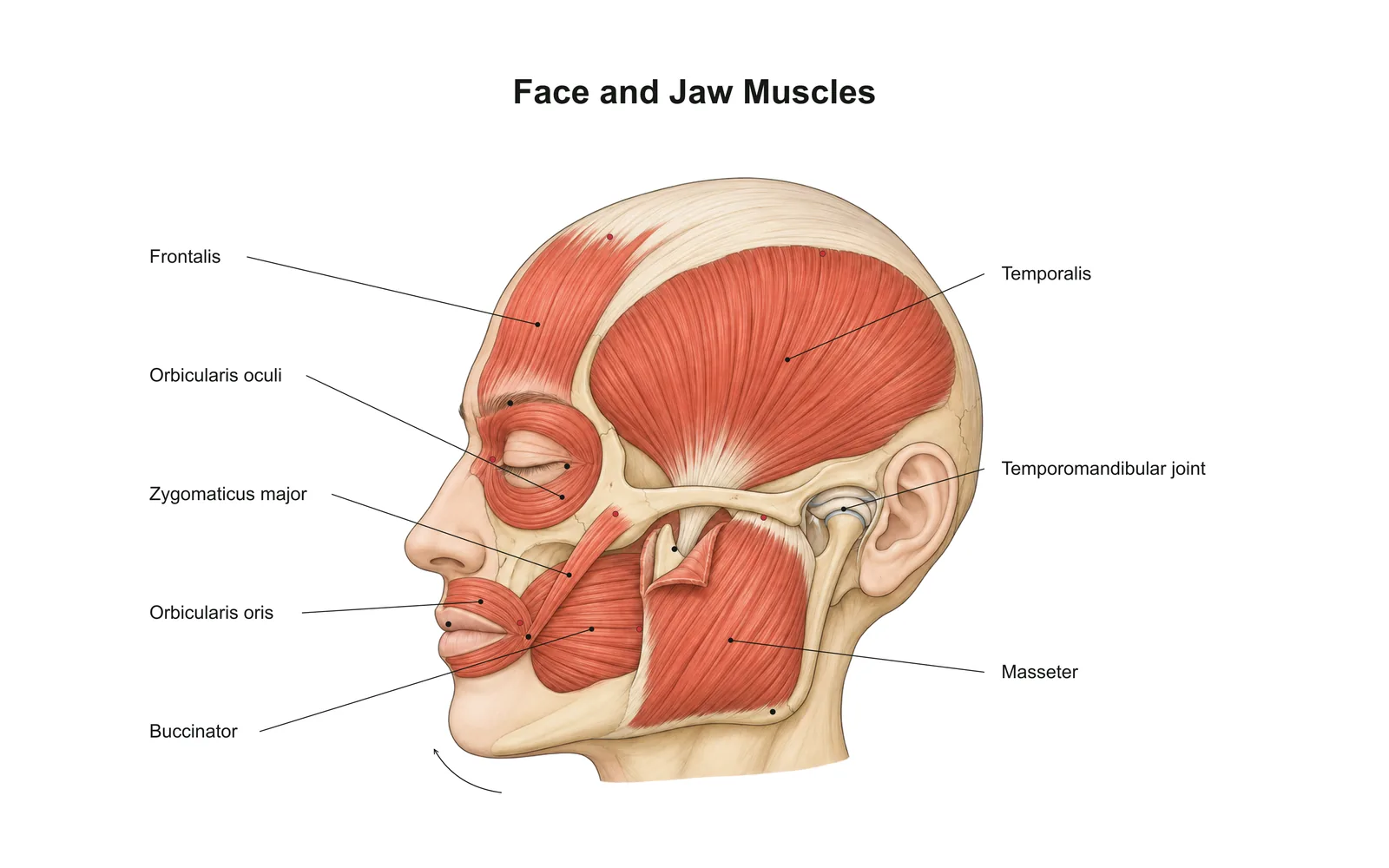
Facial expression muscles attach to skin, not just bone, so they move the face itself; all are supplied by the facial nerve (CN VII).
Four muscles chew: masseter, temporalis, medial pterygoid and lateral pterygoid, all supplied by the trigeminal nerve (CN V).
Ring-shaped (sphincter) muscles close the eyes (orbicularis oculi) and the lips (orbicularis oris).
The tongue is moved by muscles named for where they start: genioglossus (chin), hyoglossus (hyoid), styloglossus (styloid process), palatoglossus (palate).
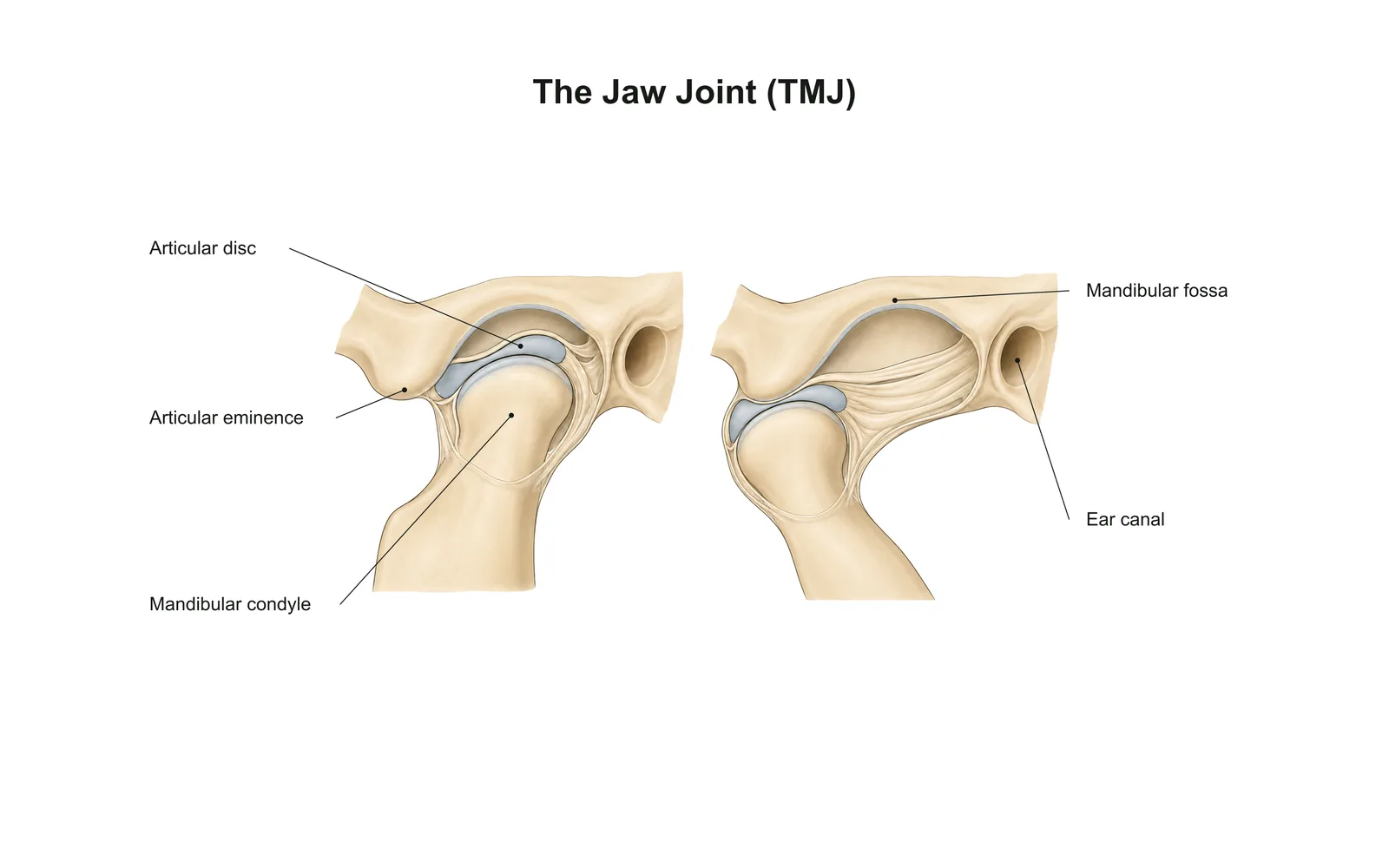
Face and Jaw MusclesThe Jaw Joint (TMJ)
Flashcards
Card 1 of 22Tap the card to flip
Space flips · ← → browse
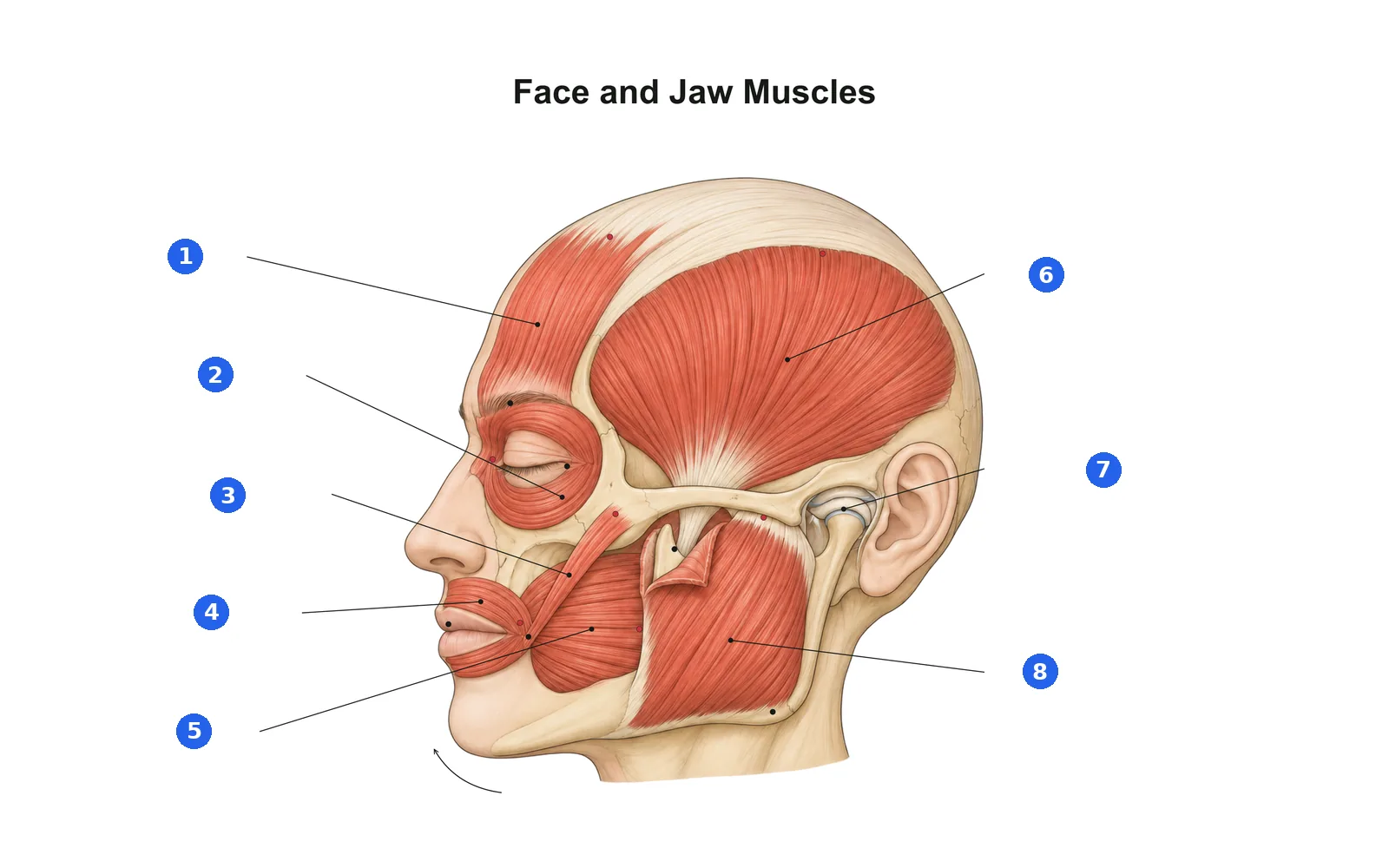
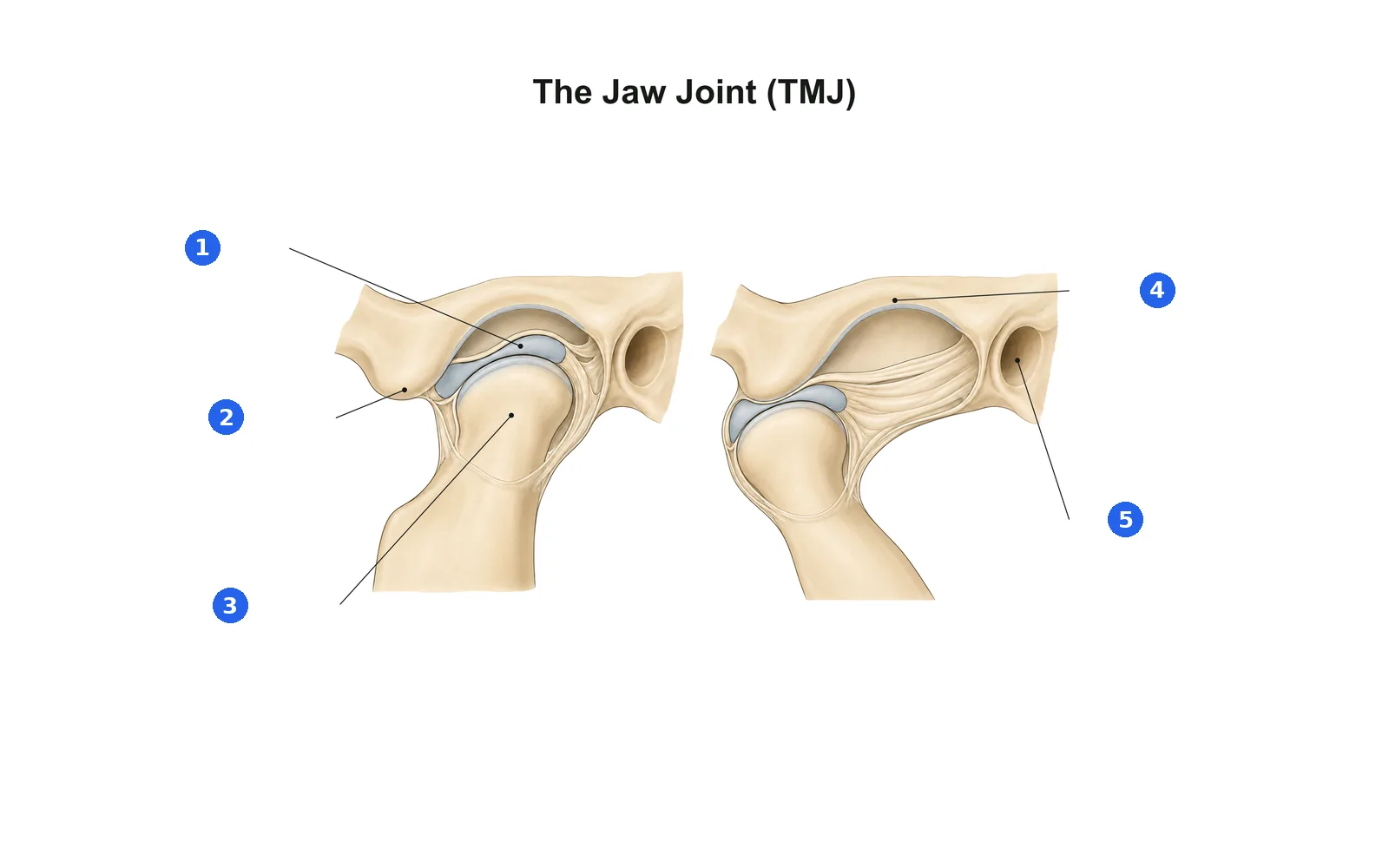
Label the diagram
Name each numbered part. Switch to the labels to study first.
Label 1 of 8Pick an answer
What is number 1?
Label 1 of 5Pick an answer
What is number 1?
Picture quiz
Name the part shown in orange.
Picture 1 of 6What is the highlighted muscle?
Terms in this deck (22)
Frontalis
The forehead muscle; raises the eyebrows and wrinkles the forehead.
Orbicularis oculi
The ring of muscle around the eye that closes the eyelids, from a gentle blink to a tight squeeze.
Corrugator supercilii
Pulls the eyebrows down and together, making the vertical frown lines between them.
Procerus
A small muscle over the bridge of the nose that pulls the brows down and wrinkles the top of the nose.
Nasalis
Flares or compresses the nostrils.
Zygomaticus major
The main smiling muscle; pulls the corner of the mouth up and out.
Zygomaticus minor
Lifts the upper lip, helping to show the upper teeth when smiling.
Levator labii superioris
Raises the upper lip.
Risorius
Pulls the corner of the mouth straight out to the side, as in a grimace.
Orbicularis oris
The ring of muscle around the mouth that closes and puckers the lips, as in whistling or kissing.
Buccinator
The cheek muscle; presses the cheek against the teeth to keep food between them and helps blow air out.
Depressor anguli oris
Pulls the corner of the mouth down, as in frowning or sadness.
Mentalis
Wrinkles the chin and pushes the lower lip out, as in pouting.
Masseter
The strongest chewing muscle; runs from the cheekbone to the angle of the jaw and closes the mouth with force.
Temporalis
A fan-shaped chewing muscle at the side of the head that closes the jaw and pulls it back.
Medial pterygoid
Closes the jaw and helps grind food from side to side.
Lateral pterygoid
Opens the jaw and pushes it forward and to the side; the only chewing muscle that helps open the mouth.
Genioglossus
The main muscle that sticks the tongue out; it runs from the inside of the chin into the tongue.
Digastric
A two-bellied muscle under the jaw that opens the mouth and lifts the hyoid bone when swallowing.
Mylohyoid
Forms the floor of the mouth and lifts it (and the tongue) when swallowing.
Occipitalis
The muscle at the back of the scalp; pulls the scalp backward, working with the frontalis.
Which nerve supplies the facial expression muscles?