Apprentissage 2D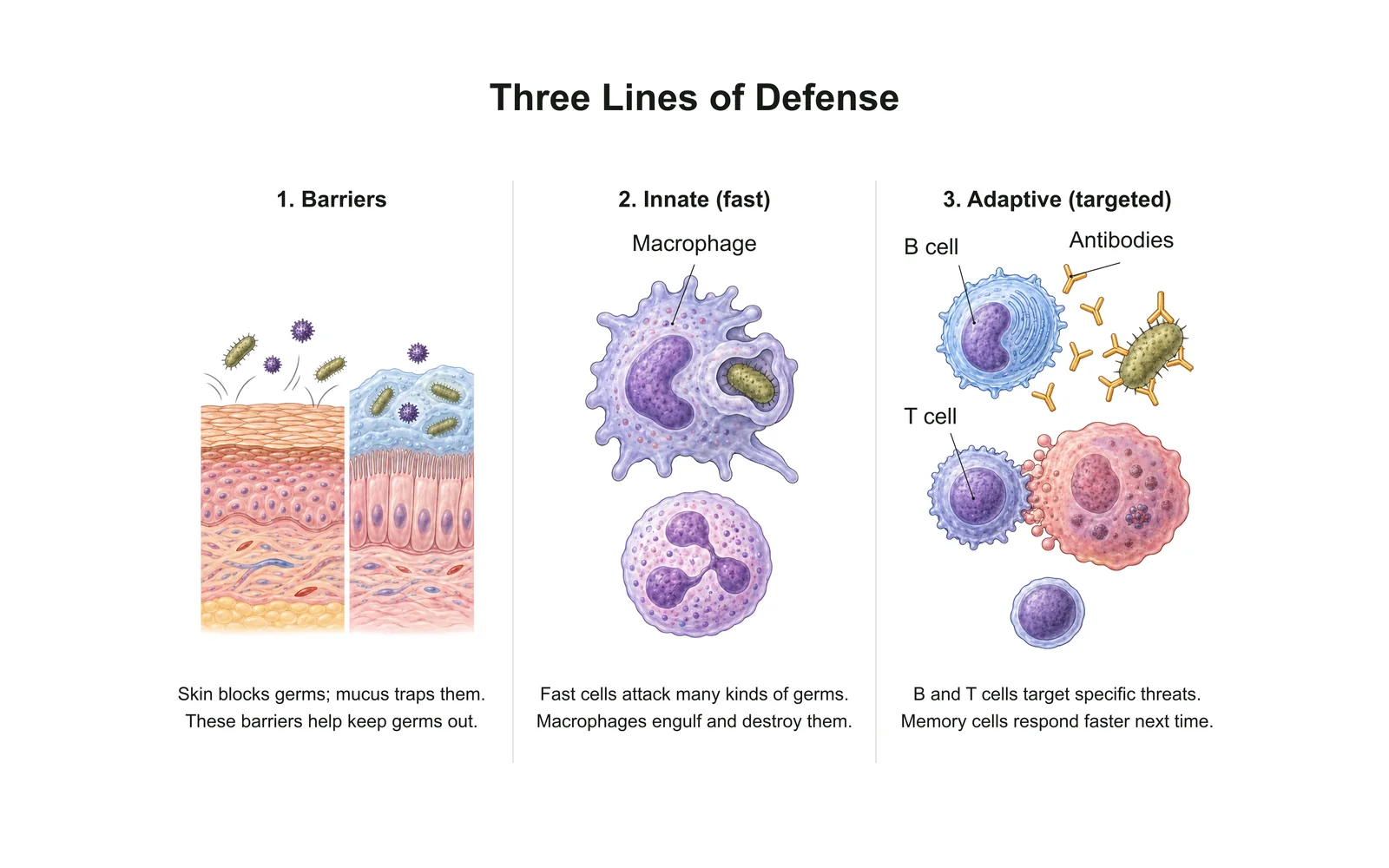
Three lines of defense, from skin to antibodies. 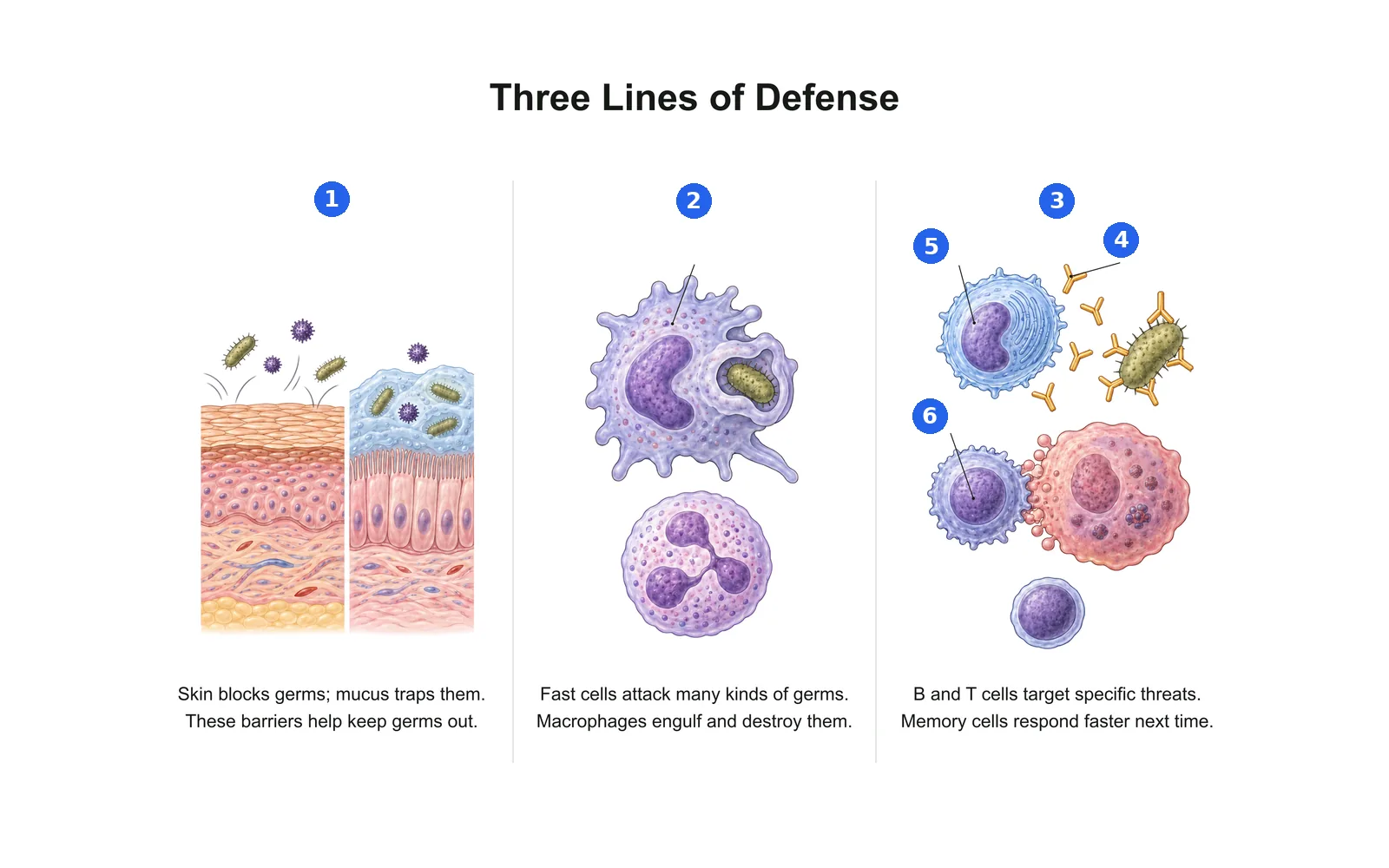
Apprentissage 2D
How Immunity Works
How it works · Immunity · 12 cartes
Notes d'étude
- The body defends itself in layers: barriers, then fast general defenses (innate immunity), then targeted defenses (adaptive immunity).
- Innate immunity reacts within minutes to anything foreign.
- Adaptive immunity takes days the first time but remembers each germ, so it reacts faster next time.
- Vaccines train adaptive immunity safely, without causing the full disease.
Cartes mémoire
Carte 1 sur 12Touchez la carte pour la retourner
Légende le schéma
Nomme chaque partie numérotée. Passe aux légendes pour étudier d'abord.
Légende 1 sur 6Choisissez une réponse
Quel est le numéro 1 ?
Termes de ce paquet (12)
- First line of defense
- Barriers that keep germs out: skin, mucus, tears, stomach acid and tiny hairs in the airways.
- Innate immunity
- The fast, general defense present from birth: inflammation, fever and germ-eating cells.
- Adaptive immunity
- The targeted defense that learns to recognize specific germs and remembers them.
- Phagocytes
- White cells such as neutrophils and macrophages that swallow and destroy germs.
- Inflammation
- Redness, heat, swelling and pain as blood flow and immune cells rush to an injured or infected area.
- Antigen
- A marker on a germ or substance that the immune system recognizes as foreign.
- Antibodies
- Y-shaped proteins made by B cells that lock onto antigens and flag germs for destruction.
- B cells
- White cells that make antibodies; some become memory cells.
- T cells
- White cells matured in the thymus: helper T cells direct the response, killer T cells destroy infected cells.
- Immune memory
- Memory B and T cells that remember a germ so the next response is faster and stronger.
- Vaccine
- A harmless version or part of a germ that teaches the immune system to recognize it.
- Why do you get a fever?
- The brain raises body temperature to slow germs and speed up immune cells.
Le voir sur le corps 3D
Ouvrez le modèle 3D sur une partie, avec ses notes et fiches d'École.
Contenu éducatif pour apprendre l'anatomie, pas un avis médical.