Apprentissage 2D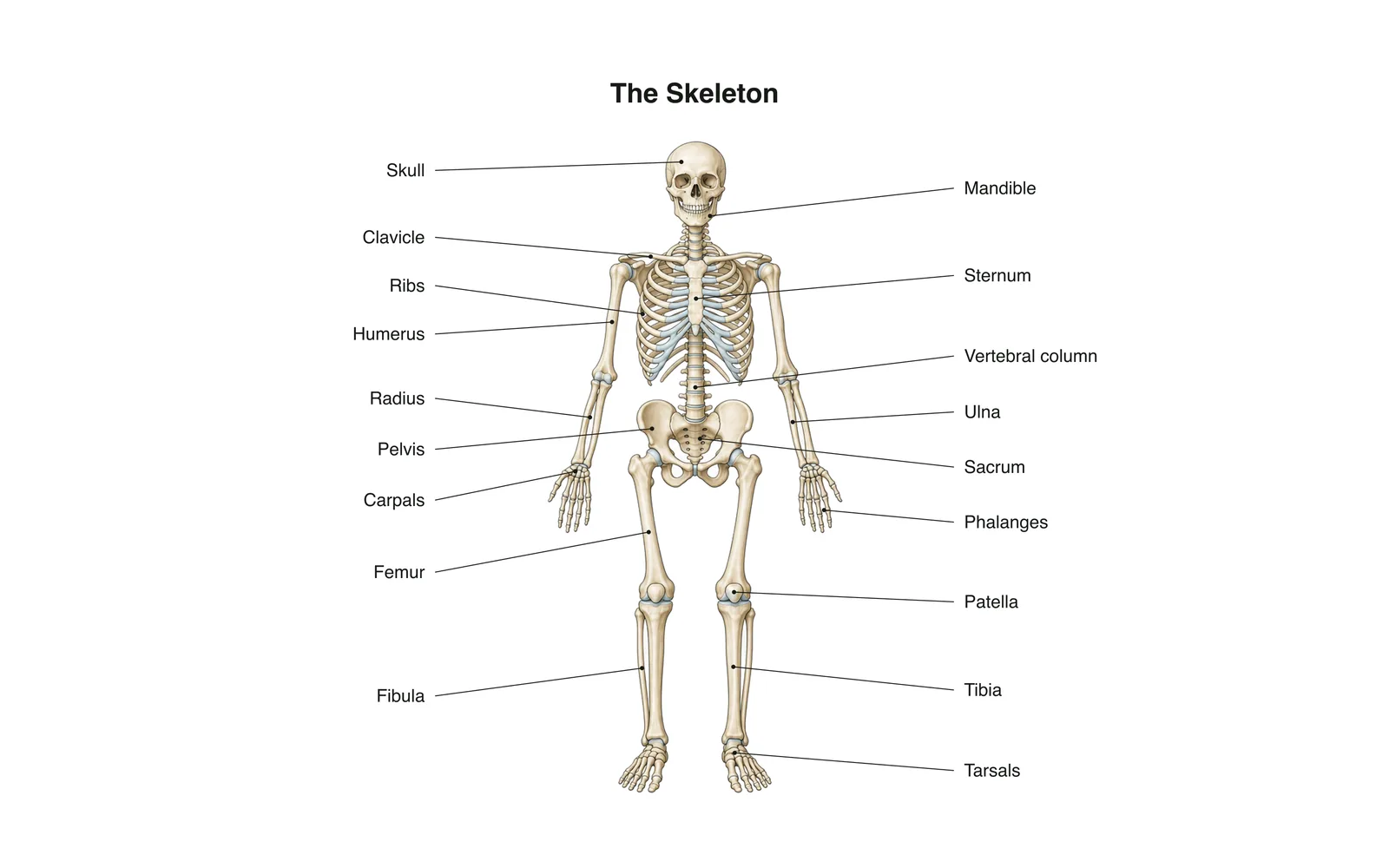
Apprentissage 2D
The Skeleton
How it works · Body maps · 18 cartes
Notes d'étude
- An adult skeleton has 206 bones; a newborn has about 300 that fuse as they grow.
- The axial skeleton (skull, spine, ribs, sternum) protects the brain, spinal cord and chest organs.
- The appendicular skeleton (shoulders, arms, pelvis, legs) lets us move and handle things.
Cartes mémoire
Carte 1 sur 18Touchez la carte pour la retourner
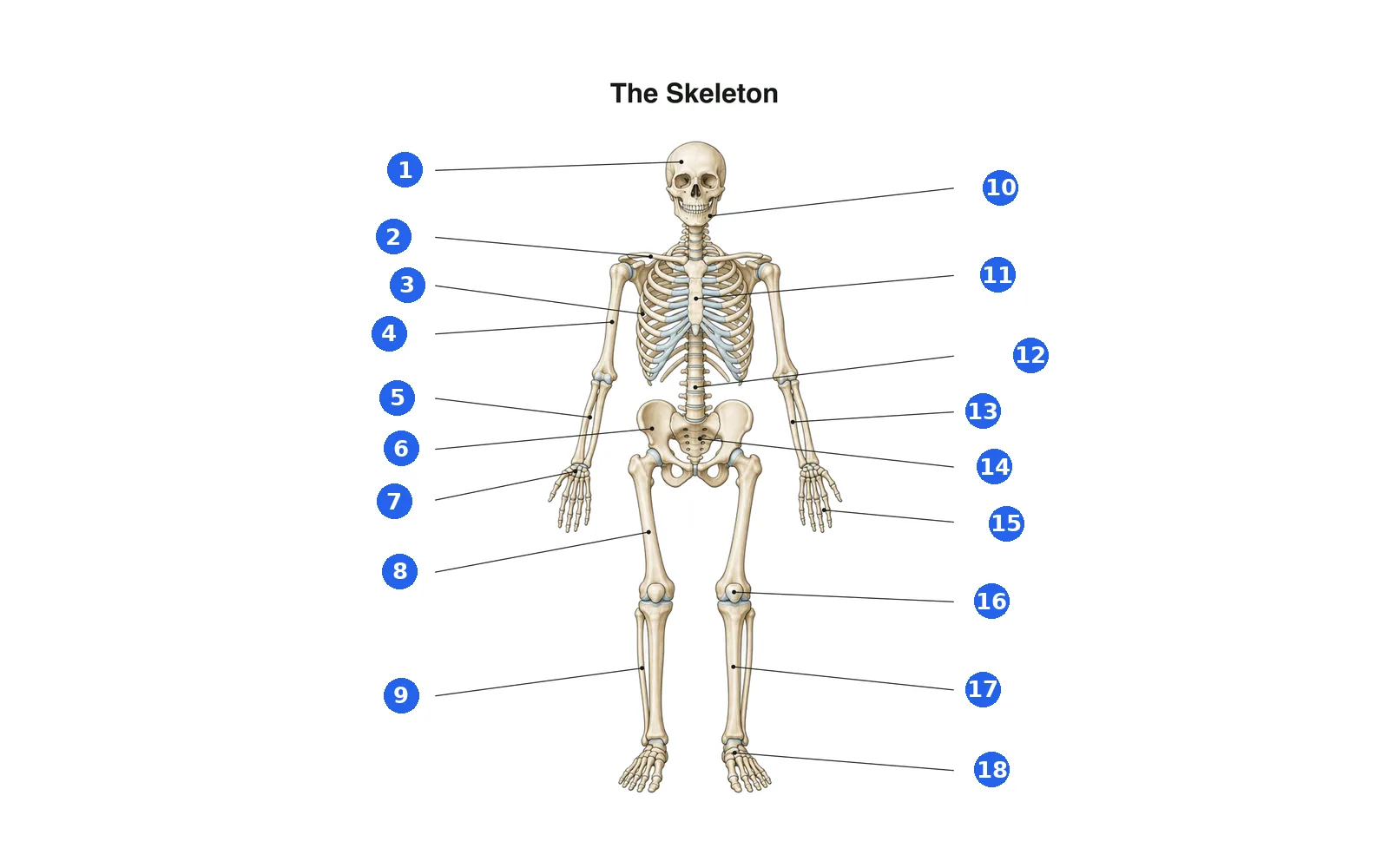
Légende le schéma
Nomme chaque partie numérotée. Passe aux légendes pour étudier d'abord.
Légende 1 sur 18Choisissez une réponse
Quel est le numéro 1 ?
Termes de ce paquet (18)
- Skull
- The bones of the head; it protects the brain and shapes the face.
- Mandible
- The lower jaw, the only skull bone that moves.
- Clavicle
- The collarbone, a strut between the breastbone and shoulder.
- Sternum
- The breastbone, in the middle of the chest; the ribs attach to it.
- Ribs
- 12 pairs of curved bones that protect the heart and lungs.
- Humerus
- The upper-arm bone, from shoulder to elbow.
- Vertebral column
- The spine: 33 vertebrae stacked around the spinal cord.
- Radius
- The forearm bone on the thumb side.
- Ulna
- The forearm bone on the little-finger side; forms the point of the elbow.
- Pelvis
- The ring of hip bones that carries the upper body's weight to the legs.
- Sacrum
- Five fused vertebrae at the base of the spine, joined to the pelvis.
- Carpals
- The 8 small wrist bones.
- Phalanges
- The finger and toe bones: 3 per finger or toe, 2 in the thumb and big toe.
- Femur
- The thigh bone, the longest and strongest bone in the body.
- Patella
- The kneecap, which protects the knee and helps the thigh muscles straighten it.
- Tibia
- The shin bone, which carries the body's weight.
- Fibula
- The thin bone beside the tibia; it forms the outer ankle.
- Tarsals
- The 7 ankle and back-of-foot bones, including the heel bone.
Le voir sur le corps 3D
Ouvrez le modèle 3D sur une partie, avec ses notes et fiches d'École.
Contenu éducatif pour apprendre l'anatomie, pas un avis médical.