Aprendizaje 2D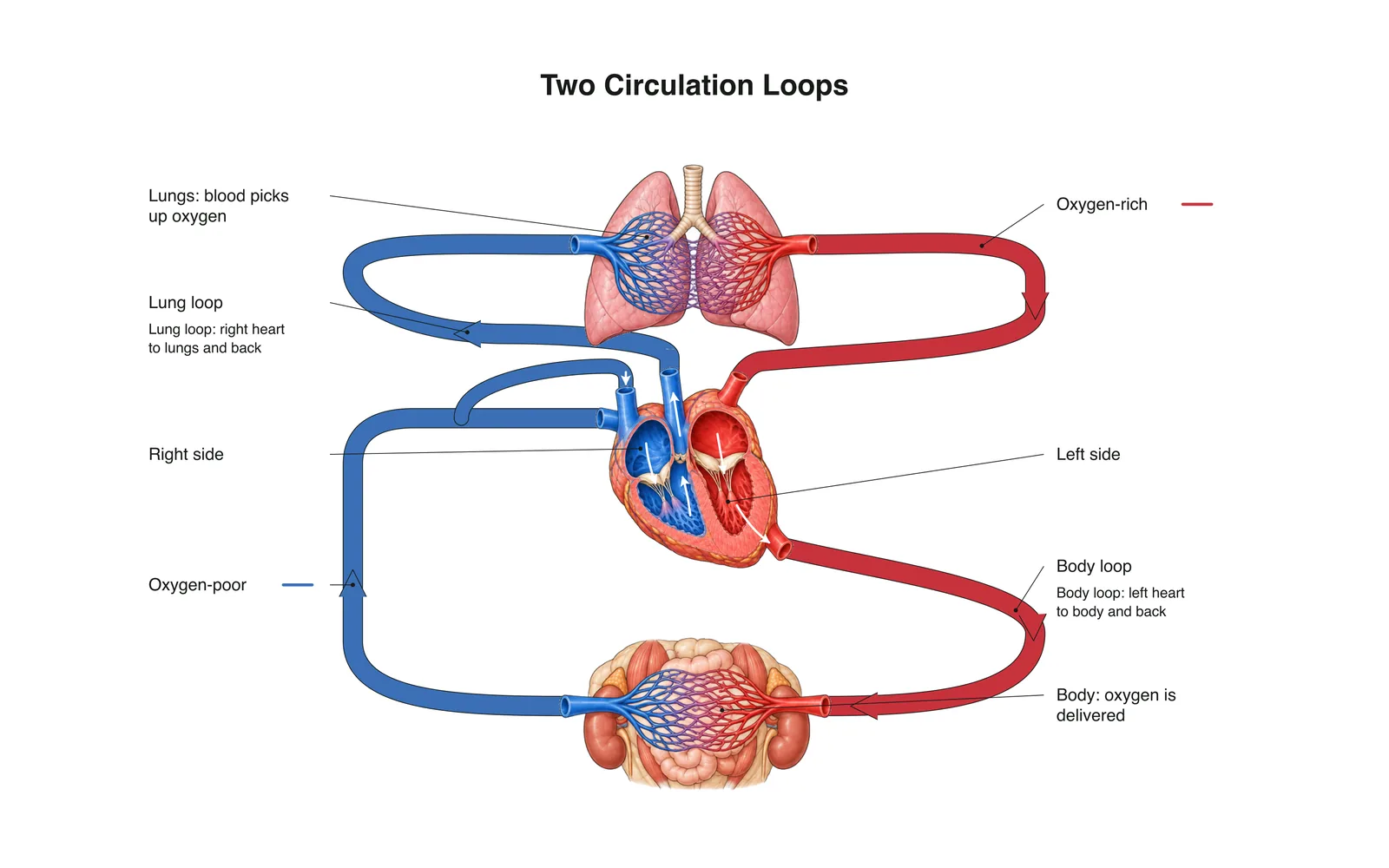
Two circuits: the lungs loop and the body loop. 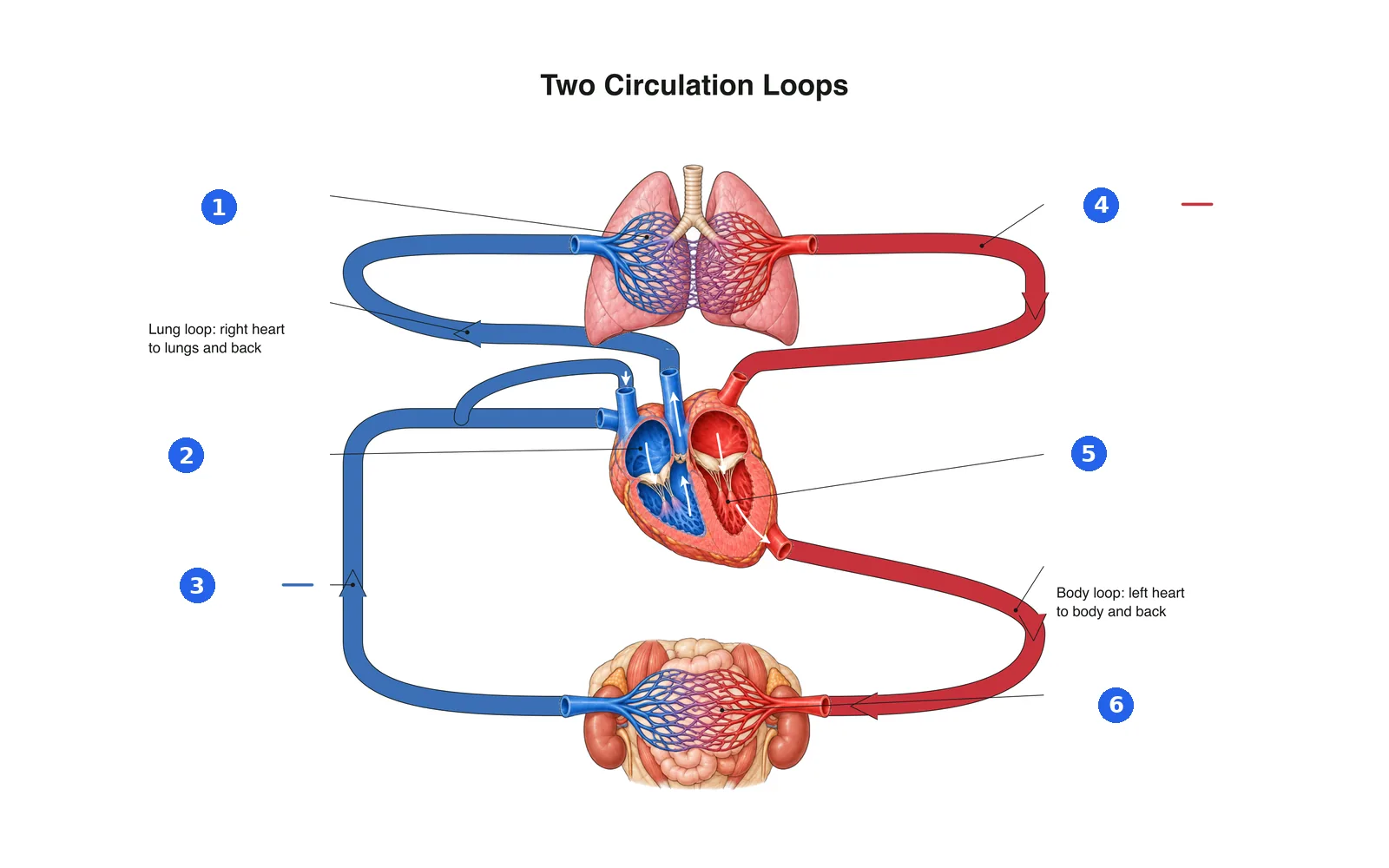
Aprendizaje 2D
Blood Vessels and Circulation
How it works · Blood and circulation · 10 tarjetas
Notas de estudio
- Blood travels in two loops: the right heart pumps it to the lungs, the left heart pumps it to the rest of the body.
- Arteries carry blood away from the heart; veins bring it back.
- Capillaries are the tiny vessels where oxygen and nutrients pass into the tissues.
- Blood pressure is the force of blood on artery walls, written as two numbers, such as 120/80.
Tarjetas
Tarjeta 1 de 10Toca la tarjeta para darle la vuelta
Etiqueta el diagrama
Nombra cada parte numerada. Cambia a las etiquetas para estudiar primero.
Etiqueta 1 de 6Elige una respuesta
¿Qué es el número 1?
Términos de este mazo (10)
- Pulmonary circulation
- The loop from the right side of the heart to the lungs and back, where blood picks up oxygen.
- Systemic circulation
- The loop from the left side of the heart to the whole body and back.
- Arteries
- Thick, elastic vessels carrying blood away from the heart under high pressure.
- Veins
- Thinner vessels carrying blood back to the heart; many have valves to stop backflow.
- Capillaries
- Vessels one cell thick where gases, nutrients and waste are exchanged with tissues.
- Systolic vs diastolic pressure
- Systolic (top number) is pressure as the heart beats; diastolic (bottom number) is pressure between beats.
- Pulse
- The wave of pressure you can feel in an artery with each heartbeat.
- Coronary arteries
- The arteries that supply the heart muscle itself with blood.
- How does blood in the legs get back to the heart?
- Calf muscles squeeze the veins as you move, and valves keep the blood flowing upward.
- Pulmonary arteries
- The only arteries that carry oxygen-poor blood, from the heart to the lungs.
Verlo en el cuerpo 3D
Abre el modelo 3D en una parte, con sus notas y tarjetas de Escuela.
Contenido educativo para aprender anatomía, no consejo médico.